

Demos Lost Their Original Purpose
Something weird has happened with game demos in 2026. If you’ve been browsing Steam, GOG, or Epic lately, you’ve probably noticed the same thing I have: there are demos everywhere. Not just for small indie projects either. Demos for idle games, incremental games, survival games, shooters, mining games, exploration games—you name it.
At first glance that sounds great. Demos used to be a staple of gaming culture. They were how players tried a game before committing to a purchase. But the modern wave of demos is being used very differently, and honestly it’s starting to get frustrating.
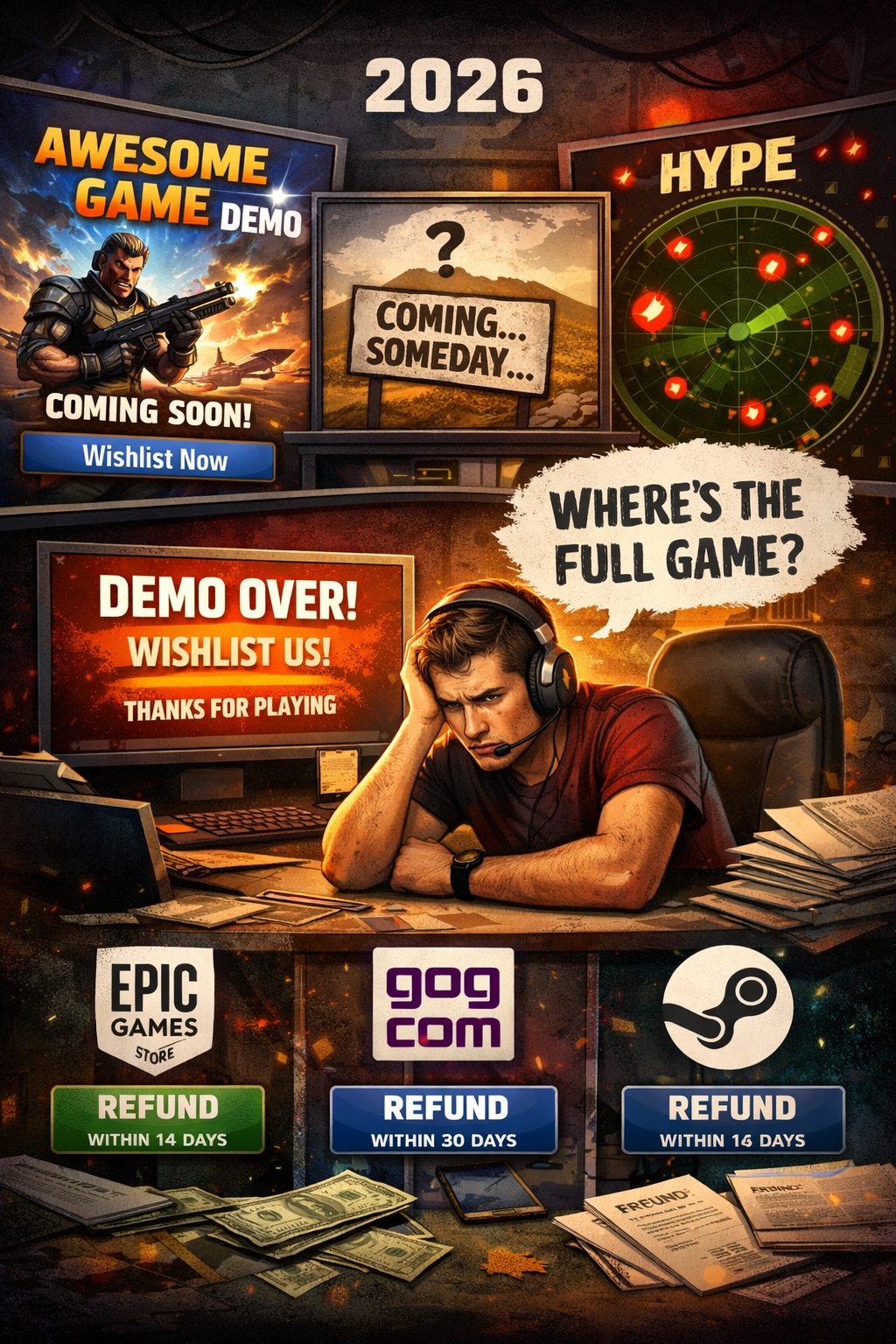
What’s happening now is that developers release a short, polished demo designed to hook you. It’s fun, it’s engaging, and it makes you want more. But when the demo ends… that’s it. There’s no full game available to buy.
Even worse, the promotional screenshots and videos on the store page often show features and gameplay that are clearly far beyond what the demo actually contains. You finish the demo expecting to continue the experience, only to discover the real game doesn’t exist yet.
You’re not buying the game. You’re wishlisting the possibility of a game.
And that’s where the modern demo trend starts to break down.
What Demos Used To Be
Traditionally, demos were released after the game was already complete or at least very close to release. The purpose was simple: give players a small slice of the finished product so they could decide whether they wanted to buy it.
You played the demo. If you liked it, you bought the full game and continued your progress.
The demo was a preview of something real that already existed.
What we’re seeing now is something different entirely. Demos are being used as marketing tools to boost wishlists and algorithm placement long before the actual game exists. It’s like a step beyond the “wishlist our game” stage.
Someone somewhere probably tried explaining the proper purpose of demos in a classroom at some point—maybe a professor, maybe a high school teacher. But the message clearly didn’t stick. The new wave of developers seems to treat demos as hype generators rather than previews of finished work.
One or two games doing this might slip under the radar. But in 2026 it feels like everybody is doing it. The radar is lit up like a Christmas tree.
Players notice this kind of thing, and the reaction is starting to show.
Why This Strategy Backfires
When players finish a demo and can’t continue the experience, it creates friction. The excitement from the demo doesn’t convert into a sale because there is nothing to buy yet.
Instead of generating hype, it often generates frustration. The player walks away feeling like they were baited with something incomplete.
And when that happens enough times across enough games, players start changing their behavior.
Personally, I’ve reached that point. Going forward, I’m not trying your demo unless there is already a full game available for purchase.
A demo should let me preview your software so I can decide whether I want to buy it. That’s the entire point. It reduces refund requests and builds confidence in the product.
Because if players can’t rely on demos anymore, the only remaining way to test a game is to buy it and rely on the refund system.
How To Refund A Game
If developers are going to treat demos as marketing experiments instead of product previews, players are inevitably going to lean more heavily on refund systems. Fortunately, the major platforms all provide refund options.
Epic Games Store Refund
Epic allows refunds for games within 14 days of purchase as long as you have played less than two hours.
To request a refund:
If the game meets the playtime and purchase window requirements, refunds are usually processed automatically.
GOG Refund
GOG has one of the most generous refund policies in PC gaming. They allow refunds within 30 days of purchase, even if you have downloaded or played the game.
To request a refund:
GOG support reviews the request and processes the refund if it qualifies under their policy.
Steam Refund
Steam refunds are widely used and fairly straightforward. The general rule is that you can request a refund within 14 days of purchase if you have played less than two hours.
To request a refund:
Most eligible refunds are approved automatically and returned to your original payment method or Steam Wallet.
The Bottom Line
Demos are supposed to build trust between developers and players. They are meant to showcase a real product that players can immediately continue if they enjoy it.
Using demos purely to farm wishlists undermines that trust. And once players stop trusting demos, they stop playing them.
If the industry wants demos to remain a useful tool, it might be time to return to the original idea: release a demo when there is actually a game ready to buy.
Until then, the refund button might become the new demo.
Something weird has happened with game demos in 2026. If you’ve been browsing Steam, GOG, or Epic lately, you’ve probably noticed the same thing I have: there are demos everywhere. Not just for small indie projects either. Demos for idle games, incremental games, survival games, shooters, mining games, exploration games—you name it.
At first glance that sounds great. Demos used to be a staple of gaming culture. They were how players tried a game before committing to a purchase. But the modern wave of demos is being used very differently, and honestly it’s starting to get frustrating.
What’s happening now is that developers release a short, polished demo designed to hook you. It’s fun, it’s engaging, and it makes you want more. But when the demo ends… that’s it. There’s no full game available to buy.
Even worse, the promotional screenshots and videos on the store page often show features and gameplay that are clearly far beyond what the demo actually contains. You finish the demo expecting to continue the experience, only to discover the real game doesn’t exist yet.
You’re not buying the game. You’re wishlisting the possibility of a game.
And that’s where the modern demo trend starts to break down.
What Demos Used To Be
Traditionally, demos were released after the game was already complete or at least very close to release. The purpose was simple: give players a small slice of the finished product so they could decide whether they wanted to buy it.
You played the demo. If you liked it, you bought the full game and continued your progress.
The demo was a preview of something real that already existed.
What we’re seeing now is something different entirely. Demos are being used as marketing tools to boost wishlists and algorithm placement long before the actual game exists. It’s like a step beyond the “wishlist our game” stage.
Someone somewhere probably tried explaining the proper purpose of demos in a classroom at some point—maybe a professor, maybe a high school teacher. But the message clearly didn’t stick. The new wave of developers seems to treat demos as hype generators rather than previews of finished work.
One or two games doing this might slip under the radar. But in 2026 it feels like everybody is doing it. The radar is lit up like a Christmas tree.
Players notice this kind of thing, and the reaction is starting to show.
Why This Strategy Backfires
When players finish a demo and can’t continue the experience, it creates friction. The excitement from the demo doesn’t convert into a sale because there is nothing to buy yet.
Instead of generating hype, it often generates frustration. The player walks away feeling like they were baited with something incomplete.
And when that happens enough times across enough games, players start changing their behavior.
Personally, I’ve reached that point. Going forward, I’m not trying your demo unless there is already a full game available for purchase.
A demo should let me preview your software so I can decide whether I want to buy it. That’s the entire point. It reduces refund requests and builds confidence in the product.
Because if players can’t rely on demos anymore, the only remaining way to test a game is to buy it and rely on the refund system.
How To Refund A Game
If developers are going to treat demos as marketing experiments instead of product previews, players are inevitably going to lean more heavily on refund systems. Fortunately, the major platforms all provide refund options.
Epic Games Store Refund
Epic allows refunds for games within 14 days of purchase as long as you have played less than two hours.
To request a refund:
- Go to your Epic Games account page.
- Open the Transactions section.
- Locate the game purchase.
- Select Request Refund.
- Follow the prompts to submit the request.
GOG Refund
GOG has one of the most generous refund policies in PC gaming. They allow refunds within 30 days of purchase, even if you have downloaded or played the game.
To request a refund:
- Visit the GOG support page.
- Log into your GOG account.
- Select the order containing the game.
- Choose Contact Support for Refund.
- Submit the refund request form.
Steam Refund
Steam refunds are widely used and fairly straightforward. The general rule is that you can request a refund within 14 days of purchase if you have played less than two hours.
To request a refund:
- Go to the Steam Help page.
- Select Purchases.
- Choose the game you want refunded.
- Click I Would Like A Refund.
- Submit the refund request.
The Bottom Line
Demos are supposed to build trust between developers and players. They are meant to showcase a real product that players can immediately continue if they enjoy it.
Using demos purely to farm wishlists undermines that trust. And once players stop trusting demos, they stop playing them.
If the industry wants demos to remain a useful tool, it might be time to return to the original idea: release a demo when there is actually a game ready to buy.
Until then, the refund button might become the new demo.